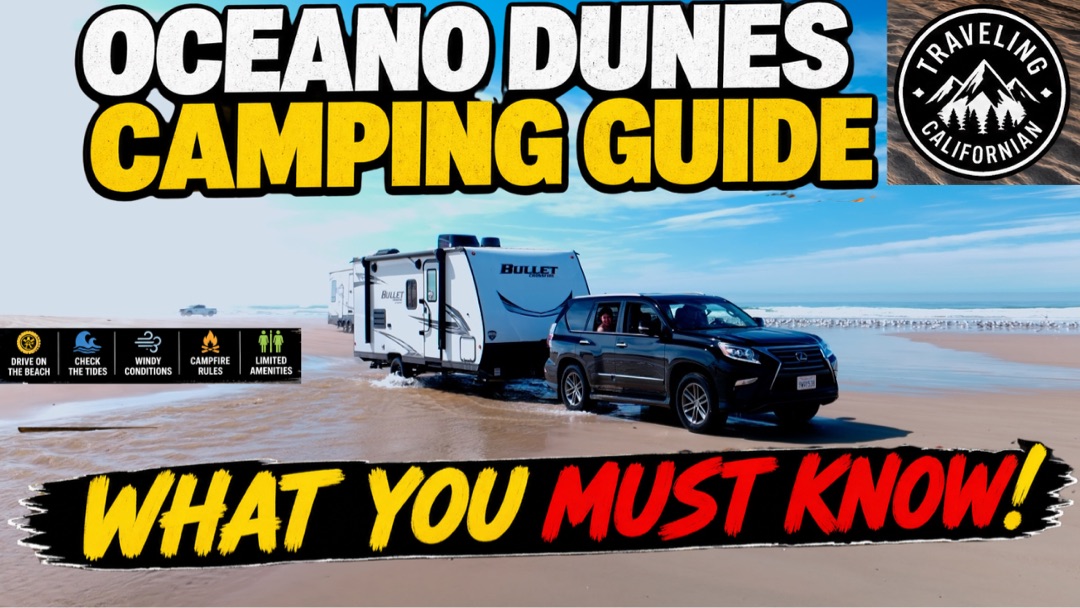
Quick answer: Oceano Dunes — part of the Pismo State Beach area on California's Central Coast — is one of the only places in the state where you can legally drive your vehicle onto the sand and camp right at the surf line. This 2026 guide covers what the dunes actually are, how reservations work, what to know about beach driving, tides and 4WD, how to set up a campsite, the safety rules that catch most first-timers off guard, family-friendly tips, a packing checklist, and the latest current-conditions alert you need to read before you book.
Recent reporting from California State Parks and the Oceano Dunes District tied to an April 9, 2026 court ruling indicates that Oceano Dunes SVRA may be temporarily closed to camping and OHV use south of Arroyo Grande Creek. Conditions are evolving, and the closure footprint and timeline may shift before your trip.
Verify current conditions before you book or travel. Check the official park page at parks.ca.gov/OceanoDunes, the Oceano Dunes District Facebook page, and call the park kiosk before driving down.
▶️ Watch the Video Guide
I put together a short video walkthrough of what an Oceano Dunes camping trip actually looks like — driving onto the sand, setting up camp, the kind of gear that earns its keep, and the mistakes I see first-time campers make every weekend. If you're a visual learner, start here:
Trouble with the embed? Watch directly on YouTube →
Like this kind of guide?
Subscribe on YouTube for weekly California family travel videos — gear, campsites, road trips, and honest reviews.
Subscribe on YouTube →What Oceano Dunes Actually Is
Oceano Dunes State Vehicular Recreation Area (SVRA) sits on the Central California coast just south of Pismo Beach, in San Luis Obispo County. It's part of the larger Pismo State Beach complex and is the only place in California where you can legally drive a street-licensed vehicle directly onto the beach and out into the dune fields.
What surprises most first-time visitors is how raw and undeveloped the camping experience is. According to California State Parks' official Oceano Dunes page, this is primitive beach and dune camping — there are no designated, numbered campsites, no hookups, no showers, and no developed campground in the traditional sense. You park on the sand, set up where you're allowed, and use vault or chemical toilets that the park maintains.
The flip side of all that primitiveness is the experience: falling asleep to the Pacific 30 yards from your tent door, waking up to fog rolling off the dunes, and the rare California treat of a campfire on the actual beach.
Reservations & Arrival
Camping at Oceano Dunes requires a reservation. Walk-ups are not the system anymore — you book in advance through ReserveCalifornia.com, the official California State Parks reservation platform.
Per ReserveCalifornia, the booking window for state park camping is six months in advance, and new dates open at 8:00 AM Pacific time (PST or PDT depending on the season). For a popular weekend at Oceano Dunes, you'll want to be logged in and clicking the moment the date drops.
Once you arrive, the day-use and entry rules are detailed on the official park page: day-use hours run 7:00 AM to 10:00 PM, and the day-use entry fee is $5 at the time of writing. For overnight stays, California State Parks lists check-in at 2:00 PM and check-out at 12:00 noon on its camping reservations page. The same page lists the kiosk addresses you'll use to enter the park.
- Book at the 6-month mark: peak weekends in June, July, and over Memorial Day / Labor Day go fast.
- Be at your computer at 7:55 AM PT on the day your date opens — refresh exactly at 8:00.
- Check current closures first: with the April 2026 alert above, confirm what's actually bookable before you commit travel plans.
- Print or save your confirmation — cell service at the dunes can be spotty.
Beach Driving, Tides & 4WD
This is the section that catches new visitors off guard, so read it twice. The California State Parks Oceano Dunes page is direct about it: 4WD is recommended for driving in the soft sand of the dune fields and along the wet/dry sand line. People bring 2WD vehicles every weekend; people in 2WD vehicles get stuck every weekend. Tow trucks operate in the area, but they're not free.
Tides matter too. The wet, packed sand near the surf is the easiest to drive on, but it's also where you'll be cut off when a high tide rolls in. Always check the tide chart before you drive south of the camping area, and never park where an incoming tide can reach you. I've seen vehicles lost at Oceano Dunes for exactly this reason.
Speed limits are tightly enforced. The California OHV regulations page calls out 15 MPH on the beach, along the shoreline, and near campsites. The same regulations cover the whip and flag requirements for off-highway vehicles and ATVs in the dunes — your OHV must have a visible whip with a flag at the required height so it can be seen over the crests of dunes. Without it, you'll be cited or turned around at the gate.
- Air down your tires: 18–22 PSI is a common range for street tires on the sand. Bring a portable air compressor to re-inflate before leaving.
- Carry a tow strap and shovel: not optional. Wood boards under the wheels work in a pinch.
- Drive in existing tracks when possible. Fresh sand is the deepest.
- Never park below the high-tide line. Look for the wet sand mark.
- Whip + flag required for OHVs/ATVs per California OHV rules.
Setting Up Camp & Amenities
Because Oceano Dunes is primitive camping, "setting up" means picking a legal spot above the high-tide line and below the dune protection lines, parking, and getting your shelter up before the wind picks up — and at Oceano, the wind always picks up by mid-afternoon.
The official park page notes that amenities are limited to vault or chemical toilets. There are no showers, no potable water hookups, no electrical, and no sewer at the camping areas. Self-contained RVs are common; tent campers bring all their own water.
A few practical setup notes I've earned the hard way:
- Stake everything heavy. Standard tent stakes don't hold in soft sand. Use sand stakes (auger or wide-blade) or buried deadman anchors.
- Bring a windbreak. A tarp or shade canopy oriented against the prevailing wind keeps camp livable in the afternoon.
- Pack out your trash. Trash service is limited; assume you'll haul everything out yourself.
- Bring more water than you think. A gallon per person per day is the floor, not the ceiling.
Rules & Safety
Most of the trouble I see at Oceano Dunes comes from people who didn't read the rules. The most important ones, drawn from the park page and the OHV regulations:
- 15 MPH on the beach, near the shoreline, and near campsites.
- Whip and flag required for OHVs and ATVs.
- Helmets for OHV riders and passengers under California law.
- Beach driving permitted only in designated areas — pay attention to posted boundaries and protected nesting zones (snowy plover habitat is roped off seasonally).
- Day-use hours 7 AM–10 PM for non-campers.
- Alcohol is restricted in some seasons and zones — check current signage at the kiosk.
Family Tips: Camping at Oceano with Kids
Oceano can be one of the best California camping experiences you'll ever have with kids — or one of the most stressful. The difference is preparation. A few things I tell every family asking about it:
- Set hard boundaries on Day 1. Define a visible perimeter for the kids — usually the truck on one side and a beach toy line on the other — so they know where camp ends.
- Pick a campsite back from the wet sand. Not just for tides — wet, cold sand at night is miserable.
- Bring real sun protection. The reflection off the sand and water doubles UV exposure. Hats, long sleeves, and reef-safe sunscreen.
- Two pairs of shoes per kid. One always ends up wet by 11 AM.
- Plan for ear plugs. Even at the dunes, OHVs and generators can be loud at night. Quiet hours help, but earplugs help more.
- Snacks and a beach umbrella turn a fussy mid-afternoon into a beach-nap success story.
Oceano Dunes Packing Checklist
Print this. Tape it to the inside of your camp box. You will forget at least one thing.
Vehicle & Sand Recovery
- 4WD vehicle (or AWD with high-clearance tires)
- Tire pressure gauge + portable air compressor
- Tow strap (no metal hooks — use soft shackles)
- Shovel
- Traction boards or scrap wood
- Whip + flag (required for OHVs)
- Helmets for OHV/ATV riders
Shelter & Camp
- Tent + sand stakes (NOT regular tent stakes)
- Tarp or canopy windbreak
- Sleeping bags rated for low 50s °F (Central Coast nights are colder than people expect)
- Sleeping pads
- Camp chairs that won't tip in soft sand (wide bases)
- Headlamps + spare batteries
- Lantern
Water, Food & Cooking
- Water — minimum 1 gallon/person/day
- Cooler with extra ice
- Camp stove + fuel
- Matches/lighter (kept dry!)
- Trash bags — pack it in, pack it out
Family / Kids
- Sunscreen (reef-safe)
- Wide-brim hats
- Two pairs of shoes per person
- Beach toys
- First aid kit
- Earplugs for sleeping
If you'd like our free, printable family travel and camping checklist that goes into more detail, you can grab it here: Free Family Travel Checklist (PDF) →
Final Thoughts & Subscribe
Oceano Dunes is one of those places that gets in your head. Driving onto the sand, watching the kids tear off toward the surf, falling asleep to the Pacific — it's worth the planning, even with the 4WD, the tides, the wind, and the current closure noise to navigate.
If you go in 2026, do these three things in order: (1) check current conditions on the official park page and the Oceano Dunes District Facebook before booking; (2) book six months out on ReserveCalifornia.com at exactly 8 AM PT; (3) pack the recovery gear even if you don't think you'll need it.
If this guide saved you a few hours of research, the kindest thing you can do is subscribe to the channel — that's where I publish all our California camping, beach, and family travel videos every week.
Subscribe to Traveling Californian on YouTube
Weekly family travel videos — Central Coast, Sierra Nevada, road trips, and gear we actually use.
Subscribe on YouTube →Safe travels out there, and tag us on Instagram @traveling_californian if you make it down to the dunes — I love seeing where folks set up. — Sid